|
| |
MACHINE GUNS
| The firearms illustrated below are examples of some of the
machine guns we have manufactured or rebuilt for customers. Because the BATF places
machine guns in different categories of ownership, our selection changes
constantly. Note, before purchasing a machine gun, make certain it is in a category
you can own in your state (For more information see LEGAL TIPS). Check this page periodically for
updates. Please drop us a line for current offerings or click CLOSE-OUTS and look at our
"class 3" list. |
 Chinese AKM in 5.56 x45 converted to
"KRINKOV" configuration |
 AK-74 5.45x39 Assault Rifle converted from
Romanian semiauto |
 Reactivated Browning 1919A4 with new side
plate and 7.62 NATO conversion kit |
 PPS 43 W.W.II Russian Submachine Gun in
7.62 x 25, rebuilt from parts kit |

Reactivated .45 ACP Thompson Model 1928 Submachine gun, AKA "Tommy
Gun" |
 M-11/9 COBRAY 9mm Submachine Gun fitted with HK
MP-5 sights |

M-4 Carbine, .223mm, select fire, built on registered
M-16 receiver |
 M-169
M-169 suppressed 9mm upper kit shown mounted on select fire M-16
lower receiver with optical sight (not included) |
 
SUITE-16 conversion options are almost endless as
evidenced by these M-4 SOCOM posters |
TERMINOLOGY & DEFINITIONS
| Machine Gun (MG) - A
firearm designed to discharge more than one cartridge with each pull of the trigger or
operating mechanism is a machine gun. The Bureau of Alcohol, Tobacco, Firearms, and
Explosives (BATFE) also considers the following firearms to be machine guns: any
firearm that can be "readily converted" into a machine gun; any malfunctioning
firearm in need of repair which discharges more than one cartridge when the the firing
mechanism is activated. Because their method of operation already places them in
the NFA classification, the configuration of the stock, barrel, bayonet lug, and flash
hider is not restricted. If a suppressor is permanently attached to the machine gun,
it too is considered a part of the gun and not subject to a separate tax. Machine
guns range in size from small .22 caliber pistols such as the Mexican Trajoe up to the .50
caliber Browning M-2 heavy machine gun. Automatic weapons firing projectiles larger
than .50 inches in diameter, including the Oerlikon 20 mm cannon and Bofors 40 mm cannon,
are generally described as destructive devices rather than machine guns, because their
ammunition normally contains an explosive charge. The electrically operated G.E.
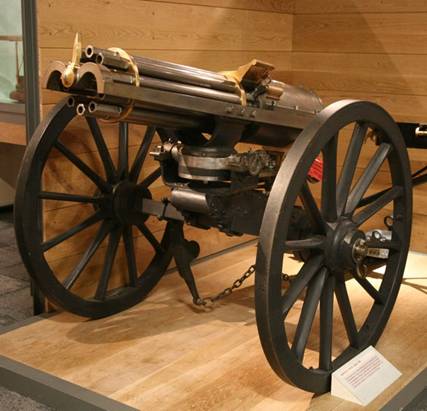
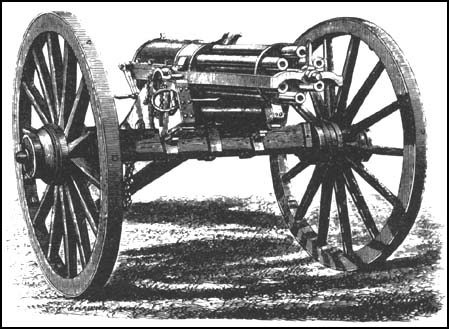
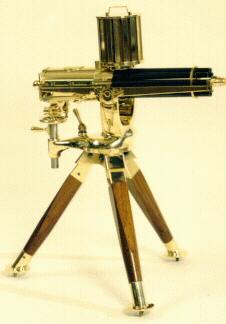
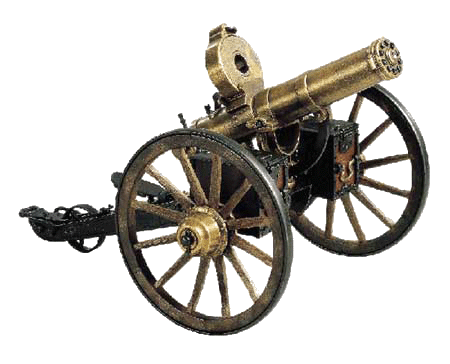
mini-gun is classified as a machine gun, although the mechanically operated Gatling gun is
not. The Federal Transfer tax on a machine gun is $200. Because machine guns
come in all shapes and sizes, various names have been conjured up to describe them.
The list below is composed of the most common terms you likely will encounter.
Technically, they are all machine guns. |
| Machine Rifle - An
archaic term for automatic rifle. |
| Assault Weapon - The
term "assault weapon" should not be confused with assault rifle.
"Assault weapon" is a recent term popularized by the news media and codified by
Congress in the 1994 Crime Bill (Brady Bill). The Brady Bill prohibits civilian
ownership of certain rifles, pistols, and shotguns built after the
enactment of the 1994 law. Assault weapons are defined by 1994 law (now lapsed) as
any new (post-94) semiautomatic firearm capable of accepting a detachable magazine and
having more than one of the following additional features: separate pistol grip, folding
or collapsible shoulder stock, bayonet lug, grenade launcher, flash hider, or threaded
barrel capable of accepting a flash hider or grenade launcher. Assault weapons are not
machine guns and are not registered by the federal government for purposes of transfer or
ownership. In legal parlance, a weapon is anything used in an offensive or defensive
manor. Therefore, some pundits prefer to use the term automatic weapon, automatic
firearm, automatic pistol, automatic shotgun, etc., when describing self-loading firearms
that have not been used in combat or self-defense. This term often is misused
to describe both semiautomatic and full automatic pistols, rifles, shotguns, machine guns,
and cannon. |
| Machine Carbine -
This term is is common parlance in Britain and Europe, but is rarely used in
America. Depending upon the particular firearm being described, it can loosely refer
to a submachine gun, carbine, or assault rifles. |
| Automatic - Depending upon
the time period involved, this term can have different meanings. When the first
self-loading firearms were invented in the 1880s, they often were referred to as
automatics, regardless of how many shots were discharged with each pull of the trigger or
activation of the firing mechanism. Technically speaking, any firearm capable of
discharging more than one shot with each pull of the trigger is a true automatic, and this
is how the term is used legally today in the United States. This includes everything
from the tiny .22 caliber Trajoe machine pistol to the 40mm Bofors anti-aircraft gun.
Also included in this definition are firearms containing burst fire mechanisms that
allow a regulated number of shots (usually two or three) with each pull of the trigger. |
| Semiautomatic - This is
the correct and legal term to describe the action of any self-loading firearm that
discharges a single shot with each pull of the trigger or activation of the firing
mechanism. Some news media erroneously use the term semiautomatic machine gun.
Such a term is a contradiction because the legal definition of a machine gun
violates the principle of one shot per each pull of the trigger.
|
| Heavy Machine Gun
(HMG) - Originally, any machine gun designed for heavy sustained firing from
a tripod and utilizing a water jacket cooling system around the barrel to dissipate heat,
hence the term "heavy". Examples include the Maxim, Vickers, and Browning
1917A1. Later this term applied to machine guns that fired bullets larger than those
used in the issue service rifles. The most popular example is the Browning .50
caliber M-2 series. |
 The original heavy machine gun was
water-cooled and so designated because of its combined weight with tripod and water
condenser canister of about 80 pounds. This one is a Vickers built adaptation of the
first self loading machine gun, the Maxim. |
 The Browning M-2 "Ma Deuce" .50 caliber
heavy machine gun is still in service in the U.S.military and other militaries of the
world |
| Medium Machine Gun
(MMG) - At first this was a lighter variant of the early heavy machine
guns. The barrel jacket water cooling system was dispensed with and a heavier barrel
substituted. This gave the weapon greater portability but reduced sustained-fire
capability. One of the best examples is the Browning 1919A4. By the advent of
W.W.II, many water-cooled machine guns such as the earlier Browning 1917 and 1917A1 were
reclassified as medium machine guns. |
 The Browning 1919A4 saw heavy action in W.W.II,
Korea, and Vietnam. Normally mounted on a light tripod or pintle mounted on a truck
or jeep, it also served in tanks, small boats, and aircraft. |
 John Browning poses with his
30-06 caliber 1917 water cooled machine gun, a much less complicated gun than the Maxim
and Vickers. Originally classified as a heavy machine gun, it was redesignated a
medium machine gun during W.W.II to avoid confusion with the more powerful M-2 .50 caliber
machine gun. |
| General
Purpose Machine Gun (GPMG) - A German invention between the World Wars, its
purpose was to provide a very flexible gun that could serve as light, medium, and even
heavy gun by adding or subtracting features such as tripods, bipods, shoulder stocks,
sights, ammo carriers, and barrels. The real secret of the concept was the
quick-change barrel system that allowed a hot barrel to be replaced in seconds, thus
maintaining a heavy stream of fire. Another feature of all modern GPMGs was borrowed
from the Germans - heavy use of stampings, spotwelding, and simple cast or machined
parts. Examples include the German MG-42, Belgian FN MAG 58, and American
M-60. |

The finely machined but temperamental MG34 was the first practical
general purpose machine gun to see wide military use. It could be mounted on a
tripod for fixed, defensive operations, or used with a bipod for offensive, maneuvering
operations. It was often mounted on vehicles.
|
 The mass produced MG42 made excessive use of
stampings and spot welding to speed production. It proved to be a more robust and
reliable gun than the MG34 and became the mainstay weapon of the standard German W.W.II
infantry unit. It remains in use today as the MG3, albeit in caliber 7.62
NATO. During W.W.II the US Army reverse engineered captured specimens to produce an
American version in 30-06, though after testing it was decided not to put it into
production. Features of the gun eventually were incorporated into America's first
GPMG, the postwar M60. |
 The FN MAG 58 has seen wide and popular
acceptance across the free world, and remains the mainstay weapon of most NATO
countries. |
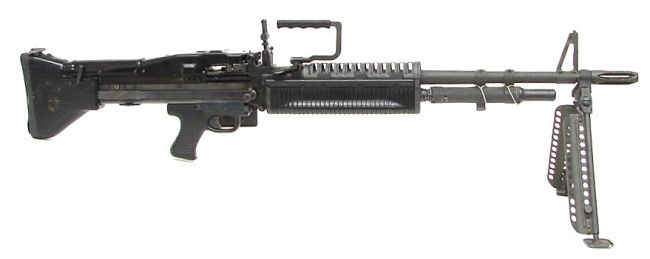 The M60 was adopted by the US Army in time to play
a key role in the Vietnam war. Despite a long development period, it was plagued
with problems which only recently have been effectively addressed. Despite its
yeoman service, it earned the unflattering moniker of "The Pig". Improved
models have been developed in recent years, but that has not prevented most M60s from
being superseded by the M240, itself a variant of the FN MAG 58. |
| Light Machine Gun
(LMG) - A lighter weight, purpose-built machine gun, usually of original
design and not converted from a heavier weapon, that fires a rifle cartridge either from a
belt or large magazine. Most LMGs have shoulder stocks and folding bipods.
Some have been adapted for tripod use such as the excellent British BREN gun. The
current trend in LMGs favors assault rifle ammunition. |
 
Though no longer standard issue in the major militaries of the
world, the BREN (left and center) has a well deserved reputation for reliability and
dependability that no LMG has exceeded. It was derived from the excellent Czech
ZB-26, which itself would be used against them by German forces in W.W.II and Chinese
forces in the Korean War. The name BREN is a compilation of BR for Brno,
Czechoslovakia, (where the design originated) and EN for Enfield, England, where it was
built under license. The MK1 (left) was chambered in .303 British and uses a heavily
curved magazine to offset the problems encountered when loading rimmed cartridges.
BRENs saw great service in W.W.II, Korea, and the colonial wars that followed.
During the Korean War British forces had the dubious honor of encountering, capturing, and
using Chinese BRENs chambered in .303 British and 7.92 Mauser. The former were UK
guns previously captured by the Japanese and later by the Chinese, while the latter were
Canadian built contract guns made for the Nationalist Chinese forces before the Communists
seized power. Many post-war Common Wealth guns were converted to the shorter and
more reliably feeding 7.62 NATO and redesignated L4 (center). These guns used a
straighter magazine and slotted flash hider.
|
 Another
LMG of W.W.II vintage was the Johnson 1941 (above). The Johnson LMG was a
modification of their Model 1941 rifle which was rushed into use by the Marine Corps early
in W.W.II. Attempts to standardize the Johnson rifle and LMG in USMC service were
scrapped (over vigorous protests from Marines who were actively using them) once adequate
supplies of M-1 Garands and BARs could be sourced from the Army, thus greatly simplifying
logistics. Though developed separately, it possesses a layout strikingly similar to
the German FG42 battle rifle described below. Also like the FG42, it fired in the
full automatic mode with the bolt open and locked to the rear to aid cooling and to
prevent an overheated chamber from igniting a round (referred to as "cook off"),
and in the semiautomatic mode from a closed bolt position to improve accuracy.
Unlike the FG42, the Johnson was recoil operated, wherein the barrel reciprocates to
unlock the action during firing. The US Army acquired 125 "Johnny
Guns" (Johnson LMGs) to equip the First Special Service Force (a joint American
Canadian airborne and mountain warfare commando raiding force), which used them in the
Aleutian Campaign where they did not encounter Japanese opposition, and in Italy where
they were successfully deployed against the Germans. Ironically, the German Fallschirmjäger
(paratrooper) forces also fought in Italy with their FG42s, though there is no
indication the units or weapons ever faced one another. |
| Automatic Rifle (AR) - Often
this term is used interchangeably with LMG. The automatic rifle is normally a rifle
caliber, shoulder fired machine gun containing a detachable magazine and folding
bipod. Perhaps the most famous example is the Browning BAR. Many post-war
designs were essentially existing service rifles refitted with bipods and selector
switches for full automatic fire, and sometimes muzzle brakes, heavier barrels, and full
pistol grips. |
 The Browning Automatic Rifle or
BAR, was invented by John Browning during W.W.I. Though superior to all other
portable automatic rifles of the period, it was only to see limited use during the war,
most notably in the hands of the sons inventor, Lt. Val Browning. It saw heavy use
in W.W.II and Korea, and soldiered into the Vietnam era. The standard US Army
infantry squad of W.W.II was built around one gun, while the Marines preferred up to three guns in each
squad. Its primary weakness was the lack of a quick change barrel and the
limitations of a 20 round magazine. Despite its 20+ lbs. of weight, soldiers and
Marines swore by it. Many Marines preferred their guns in a W.W.I configuration and
so often removed the bipod to save weight . The carrying handle, a late addition to
the gun, would likely have been removed as well. Ironically, at least two
lightweight models were developed prior to W.W.II but not adopted by the US military
(though the FBI did acquire one version called the Monitor). Some foreign
license-built copies did include quick-change barrels, pistol grips, simplified takedown,
and increased magazine capacity. The Browning Automatic Rifle or
BAR, was invented by John Browning during W.W.I. Though superior to all other
portable automatic rifles of the period, it was only to see limited use during the war,
most notably in the hands of the sons inventor, Lt. Val Browning. It saw heavy use
in W.W.II and Korea, and soldiered into the Vietnam era. The standard US Army
infantry squad of W.W.II was built around one gun, while the Marines preferred up to three guns in each
squad. Its primary weakness was the lack of a quick change barrel and the
limitations of a 20 round magazine. Despite its 20+ lbs. of weight, soldiers and
Marines swore by it. Many Marines preferred their guns in a W.W.I configuration and
so often removed the bipod to save weight . The carrying handle, a late addition to
the gun, would likely have been removed as well. Ironically, at least two
lightweight models were developed prior to W.W.II but not adopted by the US military
(though the FBI did acquire one version called the Monitor). Some foreign
license-built copies did include quick-change barrels, pistol grips, simplified takedown,
and increased magazine capacity.
|
| Battle Rifle - This
term is used to identify a full-sized self-loading rifle, usually chambered for the same
full size military cartridge used in light machine guns and automatic rifles. It may
or may not have select fire capability or a removable magazine These features
distinguish it from a carbine or assault rifle. Though intended to be fired
primarily in semiautomatic, most battle rifles have provisions for emergency full
automatic fire. Normally a bipod is not fitted to this type of rifle unless it is
being employed as an automatic rifle or light machine gun. Arguably the first such
weapon to meet all of these critera was the FG-42 which was issued to elite German
paratroopers in W.W.II. More common postwar examples include the American M-14,
Belgian FN FAL, and German G-3. All suffer from the same basic problem, too much
weight for an individual combat weapon and excessive recoil in full automatic mode, which
has led to their demise as mainstay weapons of the major world powers. |
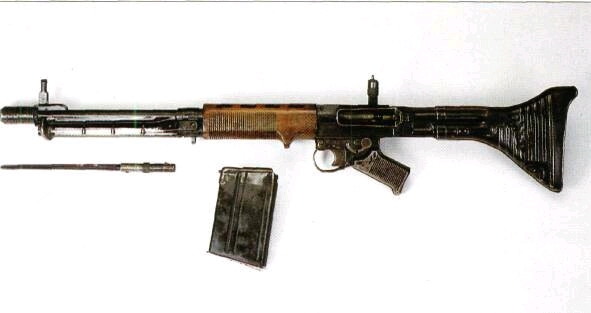 The remarkable German FG42 was created for the
Luftwaffe (Air Force) because the Fallschirmjäger (paratrooper) units were
assigned to them. After the debacle at the Battle of Crete, the paras demanded a
weapon with greater range and firepower than the MP-40 SMG, but more compact and capable
of emergency automatic fire, features that bolt action and semiautomatic rifles
lacked. The result was the first select fire battle rifle. Gas operated, and
complex, it proved difficult to produce and went through several iterations.
Estimates are that less than 7500 were built. |
 The FN FAL was the most common battle rifle of
the free world from the late 1950s to the 1990s and was nearly adopted by the US Army,
which favored the M-14 prototype. Three major patterns exist, inch, metric, and
Israeli (a combination of both patterns with a few Israeli oddities thrown in). To a
good extent, many parts will interchange between the various patterns, or can be altered
to work. During the Falklands/Malvines War both sides used the FAL as their standard
service rifle. In theory, the British had a slight logistical advantage due to their
inch pattern rifles accepting captured metric magazines (though somewhat wobbly), while
the reverse was not true. Though still in service in some counties, the FAL has
largely been supplanted by lighter and smaller assault rifles. |
 Despite a long and checkered development period
tracing back to W.W.II, the M-14 was a mainline service rifle in the US Army and Marine
Corps for only about a decade, when it was supplanted by the M-16. It remains in
limited use today primarily as a sniper rifle and special purpose weapon. A heavy
barrel squad automatic rifle version, the M-15, was not issued because tests showed a
modified M-14, called the M-14A1, performed as well. The M-14A1 saw only brief
service before being withdrawn due to excessive recoil and overheating. |
 The
German G3 evolved from the Spanish CETME, which itself was a development of a late war
German prototype assault rifle, the StG45. The MP5 SMG is based on the G3 and uses
the same roller locked delayed blowback action, though in a smaller package. As with
other battle rifles, the G3 has largely been replaced with smaller, handier assault
rifles. |
| Assault Rifle (AR) -
Although experimental and prototype examples can be traced back to the 1890s, and
some limited manufacturing of the Federov Avtomat took place in Russia during W.W.I, the
term assault rifle (or storm rifle), along with the first true mass-production belongs to
W.W.II Germany. The Wehrmacht desired a firearm blending features of the rifle,
carbine, automatic rifle/light machine gun, and submachine gun into a single weapon for
use by front line assault troops. They accomplished this in their select-fire
MP-43/MP-44/StG-44 series of weapons by reducing the standard 8 mm rifle cartridge to one
of intermediate size and power, somewhere between that of their submachine gun round and
rifle round. This was based on evidence that suggested most maneuver warfare was
conducted at ranges under 400 meters where the advantages of a long range cartridge are
lost. The concept has dominated military rifle development since W.W.II. The
Soviet AK and U.S. M-16 series of assault rifles are the most common and successful
examples to date. |
 Known by several names, the MP43, MP44, and StG
44, was an outgrowth of several earlier designs intended for use on the Russian front
where human wave tactics demanded a handier high capacity firearm capable of engaging at
ranges greater than the submachine gun but less than the slow firing bolt action rifle.
Several hundred thousand were issued and saw action on both the eastern, and to a
lesser extent, western fronts. The Soviets captured specimens and were so intrigued
by both the weapon and the ammunition, that it lead to their development of the 7.62x39
round in 1943, and the prototype AK assault rifle shortly thereafter. |
 The Air Force adopted
the M-16 as a base defense weapon in the early 1960s. The Army soon acquired it, and
later the improved M-16E1 and M-16A1 (pictured), as a limited use weapon to deal with the
jungle fighting of the Vietnam War. The premature rush to field it was coupled with
an initial shortage of cleaning kits, a general lack of proper training, and a change in
gunpowder which accelerated fouling and wear. Coupled with a small caliber high velocity
round, it soon earned a reputation among some soldiers and Marines as an unreliable
"mouse gun". The M-16A1 ultimately proved successful and lead to full
standardization within the Army and Marine Corps. |
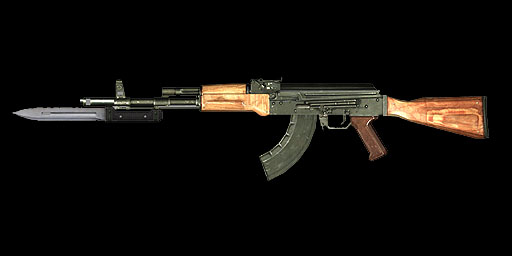
 The
superficial similarities between the Soviet AK (left) and the Stg 44 (panel above) are
readily apparent, though the AK uses a different internal design and general fabrication
techniques. Since the 1950s it has been the symbol of both communist countries and
revolutionaries around the world. Ergonomically lacking, and less accurate than the
M-16, it has a well earned reputation for being extremely robust, simple, and reliable.
Many variants exist, including a compact SMG version, but all are made with either
stamped or solid steel receivers, folding or fixed stocks, and in calibers 7.62 x 39, 5.45
x 39, or 5.56 x 45. The RPK squad automatic weapon version (right) utilizes a bipod,
longer barrel, and different rear stock. Since it lacks a belt feed and quick change
barrel, it has limited utility in this role. The AK series is believed to be the most mass
produced firearm in history, with estimates ranging from 50 million to over 80 million
produced, and still growing. |
 The M-16A2 (above) was adopted to improve the
ruggedness, handiness, and long range effectiveness of the M-16. Though it has
almost completely supplanted the earlier M-16A1, it has itself been superseded to a large
degree by the M-16A4 rifle (detachable carrying handle) and M-4, M-4A1 (below), and M-4A1
SOPMOD carbines.

|
| Submachine Gun (SMG)
- The Italians are credited with inventing the SMG, though it was the Germans who
first employed the concept effectively in the closing days of W.W.I with their MP18
(MP18/I as adopted). The SMG is a full automatic or select-fire weapon that is
distinctive from other machine guns due to its reliance primarily on pistol
ammunition. Since SMGs are heavier than pistols and employ shoulder stocks, they are
better suited to close assault and defense. The SMG reached its pinnacle of success
in W.W.II, but the assault rifle has relegated it to a secondary role as a special
purpose/police weapon. The most famous examples include the American Thompson,
German MP-40, British STEN, Russian PPSh-41, Israeli Uzi, and German MP-5. |
 Pictured above is a Model 1928 Thompson SMG,
which is a simple internal modification of the original Colt built 1921, that lowered the
rate of fire from over 900 RPM to 700 RPM or less. An even simpler design, the W.W.
II era M1, and even cruder M1A1, dispensed with such features as a removable buttstock,
Lyman adjustable sights, Cutts compensator, finned barrel, and top mounted cocking handle.
The Thompson originated as the brainchild of Brig. Gen. John T. Thompson, Director
of Arsenals during W.W.I. It was developed too late for service in W.W.I, where he
envisioned it being employed as a hand-held "trench broom". Thompson had
the design refined with the addition of a shoulder stock, sights, and removable drum
magazine. He dubbed his new pistol caliber arm a "submachine gun", and
thus was born that term. It would receive its baptism of fire during the rum wars of
the prohibition period, serving on both sides of the law. Its first limited combat
uses were by U.S. Marines fighting in the "banana
wars" in Nicaragua, Honduras, and Haiti, and by
Navy personnel and "China Marines" (4th Marine Regiment) who protected U.S.
interests during the Yangtze Patrol and defended the International Settlement
in Shanghai prior to the outbreak of W.W.II. It gave great service in
huge numbers during W.W.II, but despite continuous efforts to revise and simplify the gun,
by 1945 it largely had been replaced with the far cheaper and somewhat lighter M-3
"grease gun", much to the chagrin of many G.I.s. Nevertheless, it
continued to show up on both sides of the conflicts in Korea,
Vietnam, and a myriad of post-colonial brush wars. |
 The MP40 "Burp Gun" (referring to the
sound it makes when fired) was derived from the similar looking but more complexly
machined German MP38. Both guns were designed and built at Erma, which had a long
history of SMG manufacturing. The MP40 was compact due to its novel folding stock,
and was made up largely of stampings and plastic. It set the standard for SMGs to
follow and served in large numbers during W.W.II. It has erroneously been called the
Schmeisser, after Hugo Schmeisser, who designed some earlier SMGs, though no evidence
exists that he contributed much to the design of this gun.
|
 After the huge loss of arms at Dunkirk, the
British Army and Home Guard were in desperate need of firearms. Limited quantities
of Thompson SMGs were reaching England, but not enough to meet the demand. Having
captured some German MP38s and MP40s, the British issued a requirement for an even simpler
gun that could be mass produced in home workshops. The result was a design by
Shepherd and Turpin at Enfield, hence the name STEN. It was a gross and crude
simplication of the British Lanchester SMG (itself a copy of captured samples of the
German MP28, which was a variation of W.W.I MP18/I). Though crude and suffering from
magazine defects that were never fully corrected, the STEN was dirt cheap to make and its
various Marks (MK II pictured) were produced in the millions at home and abroad, where
they contributed significantly to the Allied victory. They became a fixture in the
proxy wars and revolutions that followed, and may even be encountered today in some remote
areas. |
 In Winter War of 1940 the Soviet Army suffered
so many casualties at the hands of Finnish troops armed with their superb Suomi KP/-31
SMG, that they instituted a policy of mass SMG armament of their own forces. Their
initial gun, the PPD-40 was soon replaced by the cruder yet more easily mass produced
PPSh-41 (Pistolet Pulemyot Shpagin) designed by Georgi Shpagin. Popularly called the
Papasha (meaning Father) by Soviet troops, this weapon, more than any other, became the
iconic symbol of Soviet resistance to Nazism. Along with the Red Star and hammer and
sickle, it was the most recognized symbol of Communism until the 1960s when the AK became
ubiquitous. |
 Inspired
by several Czech designs, the Israeli UZI first appeared in combat during the 1956 Suez
Crisis. Its compact size is attributed to the bolt design which telescopes over much
of the barrel and lends stability to the gun during firing. Rugged, reliable, and
safe to operate, its popularity has dwindled over the years in favor of more accurate
close bolt operating SMGs and compact assault rifles such as the M-4. |
 The
MP5 was developed by Heckler and Koch in West Germany in the 1960s and has evolved into
the most popular police and antiterrorist SMG in the world. Offered in several
pistol calibers, the most common is 9mm. Both burst fire and full automatic versions
are offered, along with a civilianized semiautomatic carbine. Its continued
popularity is due to its compact size, light weight, and closed bolt method of operation
which enhances first shot accuracy, a critical component in SWAT and antiterrorism work.
|
| Machine Pistol (MP)
- Generally speaking, a select fire (both semiautomatic and full automatic)
pistol, usually fitted with a detachable shoulder stock. Examples include the Mauser
type "Schnellfeuer-pistole" and similar looking Astra Model 902. More
conventional looking select fire pistols include the Star MD and PD, and the Glock
18. The Germans use this term also to describe any submachine gun (MP-40 "Burp
Gun", MP-5). With or without a stock and compensator, pistols are nearly
uncontrollable in full automatic fire due to their light weight. |
 The Mauser Model 712 was one of several
select fire variants of the famous "Broomhanlde" pistol. |
 Though outwardly very similar to
the Mauser, the semiautomatic Astra 900 and select-fire 902 had improved internal
lockwork. The German SS acquired limited quantities of the Astra prior to W.W.II
because the Wehrmacht (German Army) refused to arm them. |
 This photograph shows the internal workings of
a select fire Star. Note the unique inertial wheel which allows the shooter to
control the rate of fire. |
 The Glock 18 is one of the latest incarnations
of a select-fire pistol. The selector switch is mounted at the rear of the slide,
and the compensated barrel is optional. |
| Carbine - Originally
this term referred to a rifle with a shortened barrel and stock, but using the same
cartridge as the standard service rifle. It was intended primarily for issue to
cavalry troops or special units for whom long range shooting was not a first
priority. Shortly before the U.S. entry into W.W.II, the Army adopted a unique,
small, semiautomatic shoulder arm of incredibly light weight (5.5 lb.), which they dubbed
the M-1 Carbine. Unlike the Germans, they wanted a gun that could replace the
pistol, SMG, and rifle among rear echelon troops. Rather than shorten a rifle
cartridge as the Germans did, the Americans essentially modified a stretched pistol
cartridge (.32 Winchester). Though not as powerful as the German StG-44 Assault
Rifle, the carbine was so light and handy that it saw considerable front-line service in
W.W.II, Korea, and Vietnam. Late in W.W.II a previously deleted full automatic
feature was restored to the carbine and magazine capacity was doubled to 30 rounds.
Guns so built or retrofitted are normally marked M-2 Carbine. Though it is identical
to an M-1 carbine receiver, today any carbine receiver marked M-2 is considered a
machine gun. An M-2 conversion kit also is considered a machine gun. An M-1
Carbine that does not contain the full automatic conversion parts is considered a
semiautomatic rifle. If the M-2 kit is attached, the carbine is considered a machine
gun. |
 |
 M-2 select fire carbine with
30 round magazine, heavier stock, improved magazine catch, heavier rounded bolt,
and additional internal parts and selector switch (not visible) |
| Assault Carbine (CAR)
- This rarely used term normally refers to shortened assault rifles and sometimes M-2
carbines. |
 The XM-177E2 pictured
above was one incarnation of the SMG/assault carbine version of the M-16 that appeared
during the Vietnam War and was used mostly by special operations personnel. The Air
Force procured a very similar firearm which became the GAU-5 series. The 10" -
11.5" barrels reduced bullet performance significantly, and the shortened gas system
affected reliability. The Air Force guns were given a new lease on life when the
longer 14" fast twist barrel was adopted as the GUU-5P. The Air Force has
subsequently replaced most, if not all of these guns with the M-4 series used by the Army.
|
| Automatic Cannon
- These are self-loading automatic weapons firing projectiles larger than .50 inches in
diameter, and include the Oerlikon 20 mm cannon, M230 30mm cannon, and Bofors 40 mm
cannon. They are generally classified by BATF as destructive devices rather than
machine guns, because their ammunition normally contains an explosive charge. A
variant, the chain gun, chambers and ejects rounds by means of an external power source
such as an electric motor. |
 The 20mm Oerlikon rapid fire cannon is
a recoil operated weapon that was common on board US Navy ships during W.W.II to offer low
altitude antiaircraft defense. |
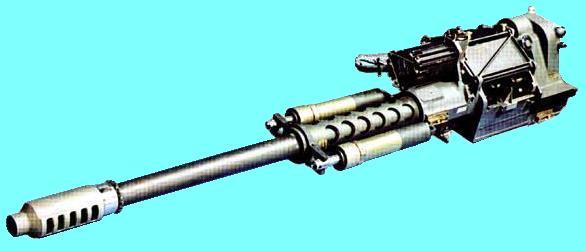 The M230 30mm automatic cannon is a
single barrel chain gun powered by an outside source. It is the primary armament of
the Apache attack helicopter. The M230 30mm automatic cannon is a
single barrel chain gun powered by an outside source. It is the primary armament of
the Apache attack helicopter. |
 The 40mm Bofors, shown
here in split quad mount, was the premier antiaircraft defense on American ships in
W.W.II, especially against the late war Kamikaze attacks. It soldiers on today in
the AC-130 gunships of the USAF. |
| Mini-Gun - These are
later variants of the Gatling design, only powered by electric motors. They can fire
at extremely high rates (up to 6000 rounds per minute). They are classified as
machine guns when chambered for rifle ammunition (such as the manportable G.E. XM214 5.56
"Six Pack" mini-gun). Larger cannon models, such as the M-61 Vulcan 20mm,
are classified as automatic cannon. These guns are sometimes referred to incorrectly
as chainguns. |

7.62 NATO caliber GAU-17 being fired by a Marine helicopter
gunner
|
 30mm
GAU-8 from A-10 "Warthog" attack aircraft |

variant of 5.56mm GE XM214 "Six Pack" |
HOME .22 RIFLE OPTIONS .22 PISTOL CUSTOM
& SCRC SUPPRESSORS SBS/AOW
SBR
CLOSEOUTS LEGAL SERVICES
ORDERS HISTORY
|